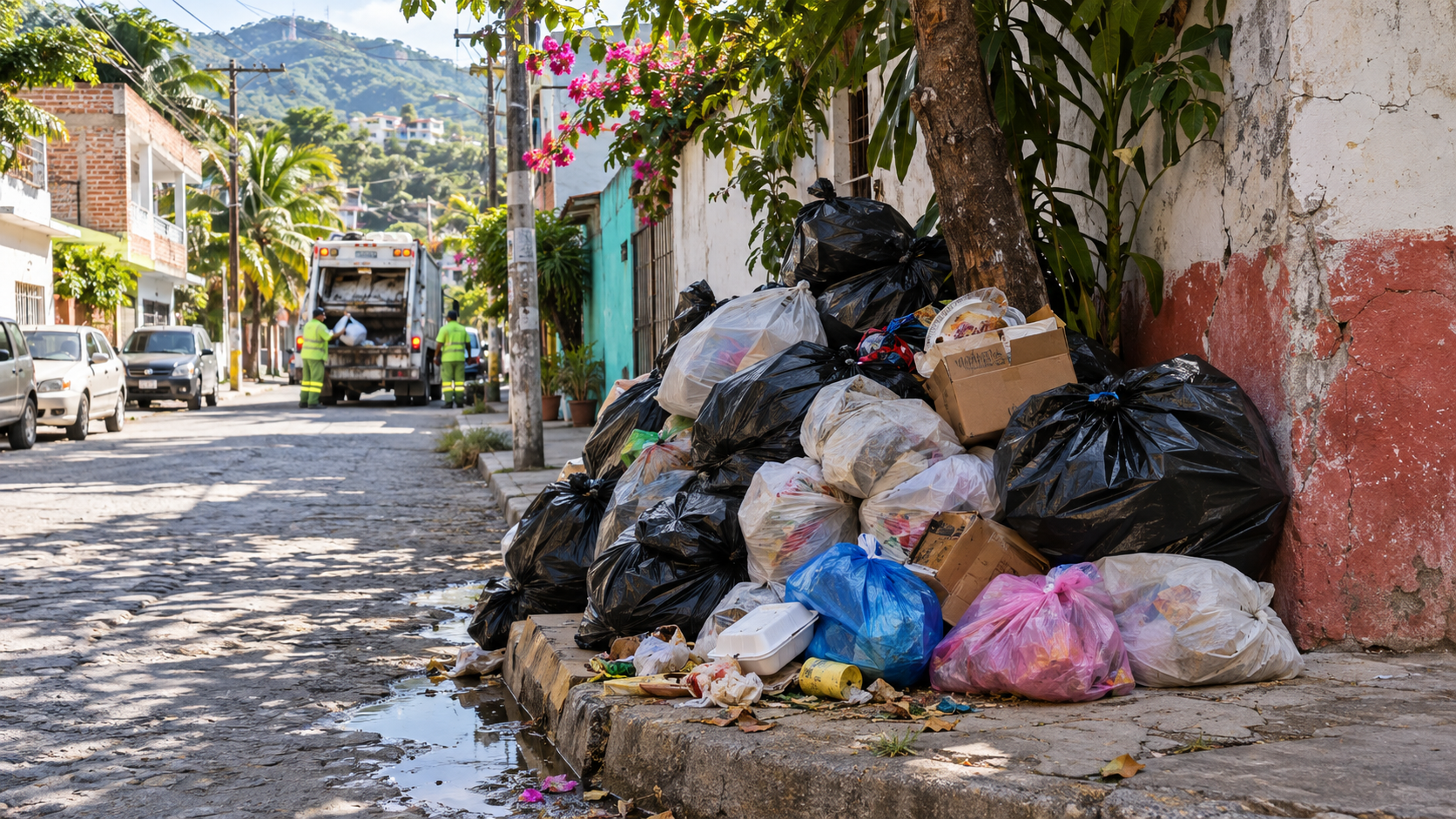
Darling, we need to talk about the trash.
And no, I’m not talking about somebody’s unfortunate behavior after three margaritas in Zona Romántica. I’m talking about actual garbage. Bags of it. Piles of it. The kind that sits on a street corner long enough for everybody in the neighborhood to start wondering whether the garbage truck has officially retired.
This is Puerto Vallarta.
A city people travel thousands of miles to experience. A place we photograph, promote, celebrate, invest in, and proudly call home.
We have beautiful beaches, magnificent sunsets, wonderful restaurants, talented entertainers, and a tourism industry that works overtime selling the idea of paradise.
But here’s the thing about paradise.
It still needs somebody to pick up the damn trash.
And according to reports coming out of multiple neighborhoods across Puerto Vallarta this November, that basic responsibility has become a serious problem.
Residents have reported waiting days, and in some cases weeks, for regular garbage collection. Some have taken their frustration to the streets. Others have reportedly resorted to burning accumulated garbage.
And now city officials have acknowledged that financial problems, broken-down collection trucks, and fuel shortages have contributed to the situation. tribunadelabahia.com.mx+2
So let’s talk about what is happening, why it matters, and why residents should not have to stage a protest to get a service that ought to work in the first place.
When Garbage Becomes a Neighborhood Emergency
For people who haven’t been following this story, the complaints aren’t coming from one isolated street.
Reports have identified collection problems in neighborhoods including El Remance, Agua Azul, Lomas del Coapinole, Moderna, Del Mar, Ramblases, El Cerro, and other residential areas.
According to reporting published by Tribuna de la Bahía on November 5, some residents said they had been without collection for periods ranging from four days to three weeks.
Three weeks.
Now, I don’t know about you, but I can barely stand having the kitchen trash sitting overnight when something in the bag starts smelling questionable.
Imagine an entire street with household garbage piling up for weeks.
And before somebody starts blaming residents for putting their garbage outside, let’s understand something.
People have to dispose of their waste. Restaurants have to dispose of their waste. Families, businesses, and neighborhoods all generate garbage every single day.
The question is whether the city has a reliable system to collect it.
That is not an unreasonable expectation.
That is municipal government 101.
On November 10, residents protesting collection failures blocked portions of the Libramiento Luis Donaldo Colosio, one of the city’s important traffic routes. Other reports described protests involving communities such as El Remance and Agua Azul. vallartabahia.globalmedia.mx+1
Think about what that says.
People weren’t blocking traffic because they wanted a new shopping center, a luxury condominium, or a prettier park.
They wanted their garbage collected.
That’s how basic this issue has become.
Some Residents Have Started Burning Their Garbage
And this is where the story moves beyond frustration and becomes a serious public health concern.
Reports from early November documented residents burning accumulated garbage after collection services failed to arrive.
One reported incident occurred in Lomas del Coapinole, where neighbors expressed concern about smoke from burning trash.
Burning household garbage is not a solution. Depending on what is being burned, smoke can contain dangerous pollutants, and uncontrolled fires create additional risks for surrounding homes and businesses.
But I think it’s important to understand the frustration behind these decisions without pretending the decisions themselves are safe.
When people believe that nobody is coming to solve a problem, some start improvising their own solutions.
Unfortunately, those solutions can create entirely new problems.
Garbage left outside attracts animals and insects, produces odors, and creates unsanitary conditions. Burning it adds smoke and fire hazards to an already unpleasant situation.
At some point, a missed garbage pickup stops being an inconvenience and becomes a community health issue.
That is why this deserves attention beyond a few angry comments on Facebook. tribunadelabahia.com.mx+1
The City Has Finally Acknowledged the Problem
Here is where the story gets especially interesting.
On November 13, Rodolfo Domínguez Monroy, Puerto Vallarta’s director of Servicios Públicos Eficientes, publicly acknowledged serious operational problems affecting garbage collection.
According to local reporting, the difficulties include insufficient funding for vehicle maintenance, delayed payments to temporary workers, problems securing diesel fuel, and too few operating trucks to meet collection demands.
Earlier reporting indicated that only 26 of the city’s 35 collection trucks were operating.
That’s nine trucks unavailable from the reported fleet.
And when a city depends on those vehicles to collect tons of garbage across numerous neighborhoods, losing approximately a quarter of its fleet is not a minor inconvenience.
It’s an operational problem that needs immediate attention.
Domínguez Monroy called on Mayor Luis Ernesto Munguía González and municipal treasurer Hugo Robles Cibrián to prioritize the money needed to restore service.
His November 13 assessment also included some encouraging news: he reported that approximately 90 percent of accumulated garbage in neighborhoods had been collected, with the remainder involving illegal dumping and waste left outside scheduled collection times.
That is progress, if the reported figures accurately reflect conditions across the city.
But let’s be clear.
A city collecting garbage after people have been forced to protest is not the same thing as a city maintaining a dependable garbage collection system.
The goal should not be to periodically rescue neighborhoods from mountains of trash.
The goal should be to prevent those mountains from forming in the first place. noticiaspv.com.mx+1
How Did Puerto Vallarta Get Here?
To understand what is happening today, we need to look back at a major decision made earlier this year.
On April 1, 2026, the municipal government took back responsibility for garbage collection and disposal after ending its arrangement with Red Ambiental, the private company previously responsible for the service.
The transition followed a troubled relationship involving service concerns and a substantial financial dispute.
Reports at the time placed the outstanding amount owed to the company at more than 200 million Mexican pesos, although the precise amount and billing calculations were disputed.
The city took control of the municipal landfill and moved forward with its own garbage collection operation. Meridiano Vallarta+2
Now, I’m not here to argue that private companies should always handle public services or that municipal governments shouldn’t operate their own systems.
There are arguments for both approaches.
But here’s what I do believe.
If you’re going to take responsibility for a service, you need to be prepared to deliver that service.
That means having the trucks.
Having the fuel.
Having employees who are paid on time.
Having the maintenance budget.
And having a plan for what happens when trucks break down, people call in sick, or an entire neighborhood needs additional collection.
Those aren’t unexpected emergencies.
They’re the everyday realities of operating a citywide waste management system.
The fact that those fundamentals are now being discussed as major obstacles raises legitimate questions about planning, budgeting, and management.
And those questions deserve answers.
Let’s Talk About the Money
Because eventually, almost every major municipal problem comes down to a familiar question.
Where is the money?
This garbage collection crisis is unfolding alongside broader reports of financial strain within Puerto Vallarta’s municipal government.
Local reporting has raised concerns about delayed payroll payments, municipal liquidity, outstanding obligations, and disagreements within the city council over financial management.
On November 13, council member Víctor Manuel Bernal Vargas publicly raised concerns about the municipality’s financial position and questioned how resources previously budgeted for essential services were being managed. sanluis.globalmedia.mx+1
Now, financial difficulties do not automatically mean wrongdoing.
Governments face complicated budgets, unexpected expenses, contractual disputes, and difficult financial decisions.
But residents have every right to ask how public money is being prioritized.
Especially when an essential service is failing.
Because I have a rather old-fashioned belief.
Before we discuss the next beautiful development, public relations campaign, or ambitious new municipal project, we might want to make certain that the existing city actually works.
You cannot build a world-class destination on top of failing basic services.
At least, not sustainably.
And Puerto Vallarta deserves better than a cycle of public complaints, emergency promises, temporary cleanups, and then more complaints.
What About the Tourism Industry?
Here’s another part of this conversation that deserves attention.
Puerto Vallarta’s economy depends heavily on tourism.
Visitors come here to enjoy beaches, restaurants, nightlife, shopping, cultural attractions, and the kind of lifestyle that makes people return year after year.
And frankly, we have a spectacular destination.
But tourism doesn’t exist in a separate universe from the people who live here.
The waiter serving cocktails at a beautiful restaurant may live in a neighborhood dealing with garbage collection problems.
The housekeeper preparing a luxury condominium for incoming visitors may return home to a street where trash hasn’t been collected.
The bartender, the chef, the musician, the driver, and the market vendor are all part of the same city.
That’s why I get frustrated when we talk about protecting Puerto Vallarta’s image without spending equal energy protecting the quality of life of the people who make that image possible.
A successful tourism destination needs more than attractive marketing.
It needs dependable infrastructure.
And that includes the neighborhoods tourists rarely see.
Because those neighborhoods are home to the people who keep this city running.
Tourism should improve life in Puerto Vallarta, not become an excuse to overlook the people living here.
The People Who Collect Our Garbage Deserve Better, Too
There is another group I don’t want lost in this conversation.
The sanitation workers.
The people who physically do this job.
Garbage collection is demanding, essential work. It requires functioning equipment, safe working conditions, appropriate staffing, dependable fuel supplies, and employees who can count on being paid.
The November 13 reporting specifically identified delays in payments to temporary workers as one of the operational problems affecting collection.
And that matters.
Because when a municipal department is struggling financially, the people doing the physical work can find themselves caught between frustrated residents and management decisions they didn’t make.
Let’s not confuse the employees collecting garbage with the officials responsible for funding and managing the operation.
A truck driver cannot repair an entire fleet with good intentions.
A sanitation worker cannot purchase diesel with a motivational speech.
And an employee should not have to wonder when the next paycheck is coming.
If we want reliable public services, we need to make certain the people providing those services have what they need to do their jobs.
That isn’t glamorous.
But neither is collecting garbage.
And both are necessary. NNC.MX
Residents Have Responsibilities, Too
Now, before everybody gets too comfortable pointing fingers at City Hall, there is another side to this conversation.
Residents and businesses also have a responsibility to dispose of their garbage properly.
That means respecting published collection schedules, avoiding illegal dumping, securing waste, and not placing garbage in public spaces unnecessarily.
The municipal director has pointed to illegal dumping and trash placed outside established pickup hours as part of the remaining cleanup problem.
That’s a legitimate concern. noticiaspv.com.mx
But here’s the distinction.
When collection schedules are unreliable, residents may struggle to know when their garbage will actually be picked up.
That doesn’t excuse illegal dumping.
It does mean the city needs to communicate clearly and consistently.
A functional system requires cooperation from both sides.
And that cooperation becomes much easier when people have confidence that the service will actually arrive.
Five Questions City Hall Needs to Answer
I don’t believe another vague promise to fix the problem is enough.
Not when residents have reportedly been waiting weeks for collection.
Not when streets have been blocked.
And certainly not when municipal officials themselves acknowledge shortages of money, trucks, and fuel.
Here are five questions I believe the city administration should answer publicly:
1. When will every affected neighborhood return to a dependable collection schedule? Residents deserve specific information, not another indefinite promise that everything will improve soon.
2. What is being done to restore the complete fleet of garbage trucks? If only 26 of 35 vehicles were operating on November 11, what is the repair plan, and when will the remaining vehicles be available?
3. How will funding for fuel, maintenance, and employee compensation be guaranteed? A service this essential should not be repeatedly interrupted by preventable operational shortages.
4. What is the verified status of the outstanding financial obligations connected to the former garbage collection arrangement? Residents deserve transparency about the municipality’s obligations and how they affect present operations.
5. How will the public measure progress? Publish collection schedules, service interruptions, working fleet numbers, and neighborhood cleanup results. Give residents something concrete to evaluate.
That is not asking too much.
That’s asking municipal government to explain how it intends to provide a basic service.
Puerto Vallarta Is Worth Fighting For
I want to make something clear.
Writing critically about Puerto Vallarta does not mean I love this city any less.
Quite the opposite.
I love living here.
I love the people, the culture, the creativity, the businesses, the extraordinary sense of community, and the beautiful chaos that makes Puerto Vallarta unlike anywhere else.
But loving a place does not require pretending everything is perfect.
In fact, I believe caring about a city means being willing to have uncomfortable conversations when something isn’t working.
And right now, something isn’t working.
Yes, officials say substantial cleanup progress has been made.
That deserves acknowledgment.
But cleanup progress is only the beginning.
The real test is what happens next week.
And the week after that.
Will garbage trucks arrive consistently?
Will neighborhoods have reliable schedules?
Will employees and equipment have the support they need?
Will residents receive meaningful answers about the financial problems behind these disruptions?
Or are we going to find ourselves having this exact same conversation again?
Because that, darling, would be the real embarrassment.
My Final Thought: Paradise Deserves Better Than This
Puerto Vallarta is a beautiful city.
But beauty doesn’t make garbage disappear.
And a destination’s reputation is not protected by ignoring its problems.
It’s protected by addressing them.
We can love this city and demand more from its leadership.
We can support tourism and insist that residential neighborhoods receive essential services.
We can appreciate sanitation workers while holding municipal management accountable.
And we can recognize cleanup improvements without pretending the entire crisis has been resolved.
That’s what responsible community conversation looks like.
To the mayor, the city administration, and everyone responsible for keeping Puerto Vallarta functioning, here’s my message:
Fix the system. Fund the service. Pay the workers. Maintain the trucks. Communicate with the residents.
We don’t need another beautiful speech about the future of Puerto Vallarta.
We need the garbage collected.
And preferably before the next sunset photo.
Because the sunsets are fabulous, darling.
The garbage? Not so much.
What is happening in your neighborhood? Are your garbage collections back on schedule, or are you still seeing delays? I AM Puerto Vallarta wants to hear from residents and business owners across the city. Share your neighborhood and experience with us so we can continue following this story.
W.N.Walker
Media King of PV | Editor-in-Chief
I AM Puerto Vallarta Magazine
IAmPuertoVallarta.com